
If you ask me, there’s a good reason we call numerals – especially the big ones – “numbers.” By their very nature, they “numb” us to the reality they quantify.
Thus, when we hear that more than 60,000 Herero and 10,000 Nama died in the 1904-1908 genocide in German South-West Africa, we don’t always think about the individual mothers and fathers, grandparents and children who were killed. Instead, we focus on the number.
The statistics of faceless genocides are something we can compare when evaluating and “ranking” the various massacres through time. Too often, society looks at those numbers to determine which genocides are over the top for human tolerance and to judge which ones deserve global condemnation or intervention.
In allowing the victims of ANY true genocide to become just a fraction of another mind-numbing statistic, we strip them of their names, their individuality … their very humanity.
And we lose our own humanity in the process.
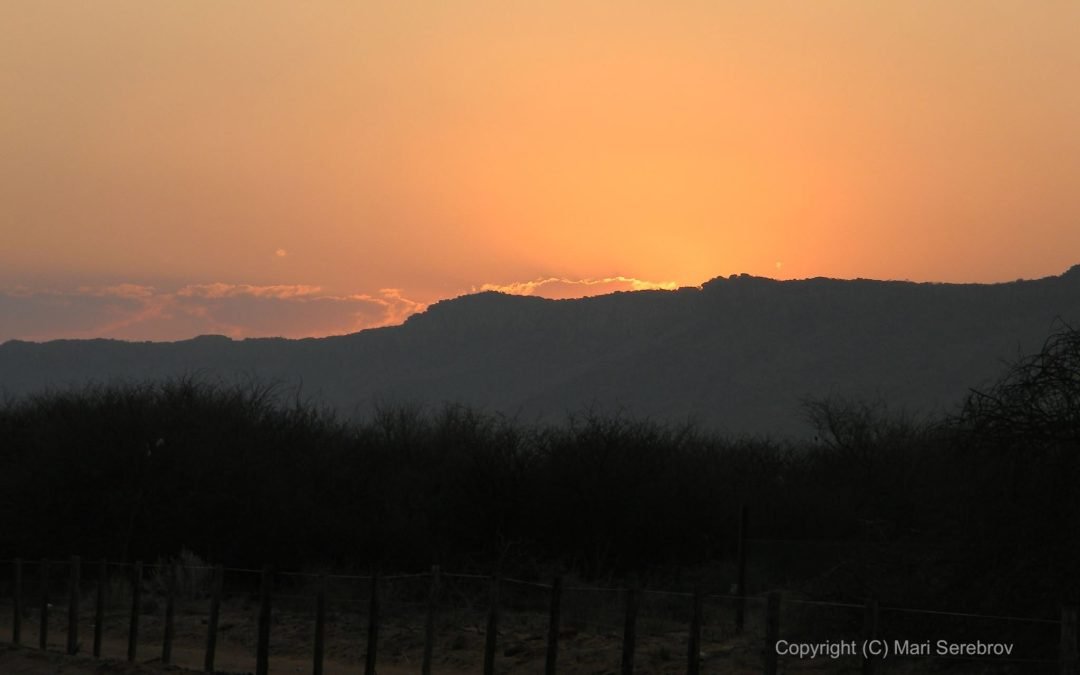
PHOTO: Sunset on the Waterberg. As the genocide intensified in 1904, the Herero, along with their herds, gathered at the Waterberg in search of safety. Gen. Lothar von Trotha brought the battle to them, hoping to surround their encampment and annihilate them once and for all. However, many of the Herero escaped into the desert, which itself brought death as the Von Trotha ordered his troops to relentlessly pursue them across the waterless landscape.